Postpartum Hair Recovery
How a Retired Midwife Helped Me Stop Postpartum Hair Shedding in 30 Days Without Expensive Products or Hospital Bills

If you had a baby in the last six to eighteen months and your hair is falling out in clumps—
If you run your fingers through your hair and they come away full.
If your shower drain looks like something died in it every morning.
If you have started parting your hair differently. Wearing it up. Avoiding mirrors. Hoping nobody notices the thin patches near your temples.
If you have tried the expensive oils. The biotin supplements. The pharmacy shampoos with the green labels and the long ingredient lists nobody can pronounce.
If you have gone to a salon and a woman looked at your scalp and said ah, it's normal after delivery — and sent you home with nothing.
If a part of you is terrified that this is permanent. That the hair you had before pregnancy is gone and it is not coming back.
If you lie awake at night googling "postpartum hair loss how long does it last" and reading answers that contradict each other.
If you have cried in the bathroom. Quietly. So the baby would not hear.
If you are exhausted. Not just from the sleepless nights and the feeding and the leaking and the healing. But exhausted from looking at yourself and not recognising the woman in the mirror.
"I know. Because I was there too. And I want to tell you something that nobody told me for almost two years."
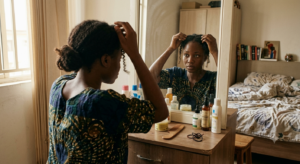
My name is Lola.
I am not a trichologist. I am not a dermatologist. I am not a hair coach or a wellness influencer with a ring light and a sponsorship deal.
I am just a woman from Abeokuta who gave birth to her second son in 2022 and spent the next nineteen months quietly losing her mind over her hair.
My husband's name is Femi. He never said anything unkind. He never would. But I know what it is like to catch your husband glancing at your hairline and quickly looking away. Like he doesn't want you to notice that he noticed.
Before I had Tunde — that's my second — I had the kind of hair women always asked me about. Full. Dark. Long. My mother's hair. I took care of it the same way she showed me. I didn't do anything fancy. I just left it alone and it thrived.
Four months after delivery, it started leaving.
Not all at once. It was slow and steady. Like water draining from a bathtub. First it was just more than usual on the pillow. Then more in the comb. Then I put my hair in a bun one Sunday morning and I could see the skin at my temples. Actual scalp. Where there had always been hair.
I spent close to ₦180,000 in one year. I want you to know that number. ₦180,000. On hair vitamins from the US. On a scalp treatment from a salon in Ikeja that cost ₦22,000 a session. On a vendor on Instagram who sold me a "postpartum hair growth oil" that smelled like burnt rubber and did absolutely nothing except make my pillow case stain.
I did castor oil. I did rice water rinses. I did the inversion method where you hang your head upside down for four minutes while your blood rushes to your face and you feel like a fool.
Nothing worked. Or — things would seem to work for two or three weeks. And then it would come back. More hair on the bathroom floor. More bare patches. More despair.
What nobody explained to me — not the doctor, not the pharmacist, not the salon women, not the Instagram pages — was why it kept coming back. Not what to put on my hair. Why the problem refused to leave.
In August 2023, I travelled back to my father's compound in Abeokuta for my cousin's naming ceremony. One of those beautiful, noisy Yoruba gatherings. Extended family from three states. Women in aso-ebi. Children running. The smell of jollof rice and egusi coming from the back of the house.
I was tired when I arrived. I had not been sleeping well. The baby was nine months old. My hair was tucked under a gele I had spent forty minutes arranging specifically to hide the thin patches at my temples. I thought I had done a good job.
I had not done a good job.
There was a woman at that gathering. Her name was Mama Ronke. Seventy-one years old. Retired midwife. She had delivered more babies in Ogun State than most hospitals. She sat in the corner of the courtyard with a wrapper around her shoulders, watching everything with the calm, heavy attention of a woman who has seen everything.
I was helping to arrange the chairs when I felt eyes on me. I turned around and Mama Ronke was looking at me. Not at my dress. Not at my face. She was looking at my hairline. And there was something in her expression — not pity. Concern. The quiet concern of someone who recognises a problem and already knows the answer.
I pulled my gele forward and looked away. I have never been more ashamed in my life.
The Discovery That Changed Everything
After the prayers and the food and the naming, when most of the guests had left and the women were packing up the serving trays, Mama Ronke found me at the back of the house washing my hands at the tap.
She did not ask me how I was. She did not make small talk. She just stood beside me and said quietly — so only I could hear:
"Your scalp is trying to tell you something. And no cream can answer it."
I started crying before I even understood why. Not polite tears. The ugly kind. The kind you have been holding for months without knowing it. I gripped the edge of the sink and I cried like something in me had been waiting for permission.
She did not rush me. She just waited. When I was done she handed me a cloth and sat down on the low wooden bench against the wall. And she began to talk.
"You see these products you women are buying from Instagram? These vitamins, these oils, these expensive shampoos — I am not saying they are bad. I am saying they are answering the wrong question. You are asking 'how do I stop my hair from falling?' when the real question is 'why has my body stopped protecting it?'"
"In the old days, a woman who just born was given four to six weeks of rest and specific foods. Not because our grandmothers were lazy. Because they understood something that modern women have forgotten. The body after delivery is not just tired. It is in a state of depletion. The hormones that protected your hair during pregnancy — they drop so fast after birth that the follicles go into panic. Into sleep mode. And if you do not give the body what it needs to wake them up again, they will stay asleep."
"So these women are spending money on the hair. But the hair is not the problem. The environment the hair is living in — that is the problem."
I was quiet for a long time after she said that. I remember a gecko running across the wall behind her head. I remember the sound of the music still going faintly from the front of the compound.
Here is what Mama Ronke explained, and what I later confirmed from everything I read and researched afterward:
Your body has a natural hormonal environment that keeps your hair follicles active and protected. During pregnancy, estrogen and progesterone rise dramatically — and they keep hair in a prolonged growth phase. That is why pregnant women often have the best hair of their lives.
After delivery, those hormones drop sharply. The follicles shift into a shedding phase all at once. This is normal. What is not normal is when that shedding continues for six, twelve, eighteen months — because the internal environment never truly recovered. The body is still depleted. Still in survival mode. Still rationing resources away from hair and toward organs it considers more urgent.
Every product you put on your hair from the outside cannot fix an internal environment that has not been reset. The scalp responds — briefly. Then the underlying depletion reasserts itself. And the shedding begins again. It is not that the products failed. It is that they were treating the symptom while the cause continued undisturbed.
"Your hair is not falling. Your body is not producing the conditions for it to stay. That is a different problem. And it has a different solution."
I sat there for a long time after she finished. Thinking about how much I had spent. How many things I had tried. How I had blamed myself — my genetics, my laziness, my bad luck.
It took one woman, in a quiet corner of a naming ceremony, to tell me what was actually happening inside my own body.
What Mama Ronke described to me that afternoon was not complicated. It was not expensive. It was a systematic way of addressing the internal depletion that keeps postpartum hair loss going long after it should have stopped. It took less than ten minutes a day. Everything needed was available at any Nigerian market or supermarket. No grinding. No steaming. No inserting anything anywhere. No pain.
She wrote it out for me on a piece of paper she tore from a small notebook in her bag. A 30-day protocol. Three phases. Each building on the last.
"Follow it exactly. Don't skip phases because you are impatient. Don't add things that are not there because your friend told you something different. And when your hair starts to come back — and it will — just smile. And maybe tell someone else."
The First Few Days: Nothing
Day 1. I went through the first steps. Felt nothing. Noticed nothing. Told myself not to expect anything yet.
Day 2. Same.
Day 3. I almost convinced myself Mama Ronke was just a kind old woman who wanted to give me something to try. Maybe there was nothing to this.
Day 4. I found more hair than usual on my pillow that morning and I almost quit. I sat on the edge of the bed and I genuinely thought: This isn't going to work either.
But I remembered what she said about phases. About the body needing time to shift. I kept going.
Day 5: The First Sign
My scalp felt different. Not dramatically. Just — different. Less tight. Less itchy. I had not even noticed the tightness until it began to ease.
When I ran my fingers across my temples, the skin felt less dry. Less angry. Like something underneath was beginning to settle.
I did not tell Femi. I didn't want to get his hopes up. Or mine.
Day 6. Day 7. Then Something Broke Open.
By day seven, the hair on my pillow was noticeably less.
By day nine, I ran a comb through my hair in the morning and I stood there staring at it. The comb was almost clean. Almost clean.
By day eleven, I noticed the small thing that still gets me when I think about it.
"I forgot to check the drain."
Every single morning for almost two years, I had checked the shower drain before I stepped out. Every single morning. It had become automatic. Compulsive. Part of the ritual of dread that started my day.
On day eleven, I got out of the shower, dried off, and went to make breakfast. It was only when I was spooning formula for the baby that I realised — I had not checked the drain. I had simply not thought about it.
That was when I knew something had actually changed.
But the real test was yet to come.
Friday Night
It was a Friday evening about three weeks into the protocol. Femi came home from work and found me in the kitchen. I was not wearing a head scarf. I had not worn my hair loose around him in almost eight months. I had always had an excuse. Too tired. Needed to moisturise it. Going to braid it tomorrow.
He stopped in the doorway and looked at me.
Not at my hair exactly. At me. The way you look at someone when something is different and you cannot immediately name what it is.
Later that night he reached for me in the dark. And I did not move away. I did not think about my hair. I did not think about whether he was looking at my temples or comparing me to the woman I used to be. I was just there. Present. With him.
Afterward, I lay there and I cried. He held me and he did not ask why. Maybe because he already knew. Maybe because he had been waiting a long time for me to come back to myself.
"He held me the way you hold someone you thought you might have lost. And I let him."
I Didn't Plan to Tell Anyone
But a month after I got back from Abeokuta, my neighbour Bisi knocked on my door to return a pot she had borrowed. She stood in my doorway for a moment and then she said: "Lola — your hair."
I told her everything. She sent me a voice note three days later: "My sister, I just want to tell you I cried when I read what you sent. Because this is exactly what I have been going through and I thought I was the only one."
Bisi told two women in her church group. Those two women told others. I started getting messages from women in Lagos, Abuja, Port Harcourt, Ibadan. Women I had never met. All of them with the same story. All of them asking for what I had.
I shared Mama Ronke's protocol with every single one of them. Woman to woman. The way these things used to be shared before Instagram made everything a sales pitch.
Here is what they told me:
Chidinma O.
"I had been shedding badly for seven months after my third child. My husband's mother kept suggesting I see a herbalist. I was desperate so I almost agreed. When Lola's protocol reached me through a friend in Lagos, I said let me just try. By day ten my pillow was almost clean. Now at four weeks I am seeing baby hairs all around my temples. Baby hairs! I nearly shouted in the salon when the hairdresser pointed them out. God bless the woman who shared this."
Amaka N.
"I spent over ₦90,000 on hair growth products after my first baby. Nothing worked for more than a few weeks. My mother thought it was spiritual. My husband thought I was exaggerating. This protocol — I don't have enough words. Week two, the shedding slowed down. Week four, my husband said 'your hair is coming back.' He noticed before I did. That's how I knew it was real."
Fatimah A.
"After my second delivery I lost so much hair I was wearing hijab at home. Even at home. My husband has never seen me without a head covering in two years. After this protocol, my hair is growing back at the front and I wear my hair uncovered at home now. My husband looked at me one evening and smiled and said nothing. He didn't need to say anything."
Ngozi E.
"Wetin people no go see. I don use everything wey them sell for Instagram — rice water, castor oil, the one wey smell like eba. Nothing work. My friend send me this thing, I do am for exactly 30 days. The bald patch wey dey near my left temple — baby hair don start to grow there. Na God. And the woman wey share this thing — God bless am."
Halima M.
"I am a nurse. I know about postpartum hair loss. I knew about the hormones. But knowing did not stop it. I tried to treat it the clinical way — the vitamins my textbooks recommended, the dietary changes. Nothing gave me the comprehensive, structured approach this protocol gave me. It addresses the whole system, not just one piece. For the first time since my delivery I feel like my body is recovering. Not just coping."
Titi B.
"My hair was falling out twelve months after delivery. Twelve months. My doctor said it would stop 'soon.' It did not stop. This protocol addressed things no doctor ever mentioned to me — the internal environment, the specific nutrition, the recovery phases. Four weeks later I have more hair than I had before I got pregnant. I am not exaggerating. My mother cried when she saw me."
Same protocol. Same approach. Same results.
Why I Am Sharing This
I went back to Abeokuta two months after the naming ceremony. I found Mama Ronke at her house in Ibara. I told her what had happened. That my hair had grown back. That I had shared the protocol with women I had never met and they were sending me messages from across Nigeria.
She laughed. A full, generous laugh that took her whole body. She slapped her knee and said: "This is what I have been telling people for forty years. But nobody wants to listen to old women anymore."
I asked her permission to write everything down. To document it properly. To share it in a form that could reach more women than voice notes and word of mouth could ever reach.
She was quiet for a long time. Then she nodded.
"Do it. But make sure they follow exactly. No shortcuts. And make sure they know this — they were never broken. They were never failing. Their bodies were just waiting for the right conditions to recover. That is all this is. Giving the body what it needs to do what it already knows how to do."
Now Available
THE MATERNAL FOLLICLE RESET™ PROTOCOL
The 30-Day Blueprint for Supporting Hair Recovery After Childbirth
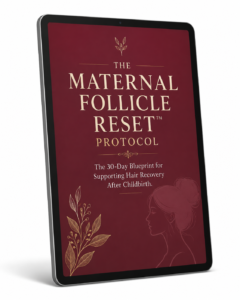
Everything Mama Ronke taught me — documented, structured, verified through the experiences of hundreds of postpartum women across Nigeria, and written in plain language so you can start tonight.
This is not a collection of generic tips you can find on Google. This is a complete, phased, 30-day system built around one central truth: your scalp cannot recover until your internal environment does.
- ✓ The Maternal Follicle Reset™ — The Complete 3-Phase System — The exact protocol Mama Ronke gave me, expanded and structured into three clear phases with daily actions. Understand not just what to do, but why each phase matters (Pg. 8)
- ✓ The Internal Reset Checklist — The specific nutritional and lifestyle adjustments that correct the internal depletion keeping your follicles in survival mode. Everything available in any Nigerian market (Pg. 14)
- ✓ The #1 Mistake Postpartum Women Make — The well-meaning habit that actively works against hair recovery. Most women are doing this without knowing it (Pg. 6)
- ✓ The Follicle Food List — Specific foods that support hormonal recovery and hair follicle signalling — sourced from what is already in your kitchen or available at the market (Pg. 20)
- ✓ Hidden Habits That Extend Shedding — Six daily habits that most new mothers don't realise are slowing their recovery. Remove these and the protocol accelerates dramatically (Pg. 24)
- ✓ Monthly Maintenance Protocol — What to do after the 30 days to keep the results permanent and prevent the pattern from returning in future pregnancies (Pg. 31)
- ✓ The Extended Protocol for Severe Cases — For women who have been shedding for more than twelve months. A modified, deeper reset for stubborn cases (Pg. 35)
You do not need to travel anywhere. You do not need to visit a clinic. You do not need to import anything. Everything described in this guide is available in your local market or supermarket. Total cost of materials? Less than ₦3,500.
Compare That to What You Have Already Been Spending
How Much Does This Guide Cost?
Before I tell you the price, I want to be transparent about what it cost me to put this together properly.
I spent months writing and rewriting this. I worked with a professional editor to make sure it was clear, structured, and genuinely useful — not just a collection of vague advice. I paid to have it formatted and designed properly. I set up a secure delivery system so you receive it instantly the moment you pay. I built this website and maintained it. And I spent months gathering feedback from the women who tested the protocol, refining the phasing and the instructions based on what actually worked.
Total investment to create and document this properly: over ₦120,000.
I am not sharing that number to impress you. I am sharing it so you understand that what you are getting is not a WhatsApp voice note or a screenshot of someone's notes. It is a properly documented, tested, structured guide — built from a real midwife's forty years of experience and the results of real postpartum women across Nigeria.
A fair price for something that took this much to build, and that addresses a problem women spend ₦100,000–₦200,000 trying to solve? It would be ₦15,000. Easily.
But I know times are hard. I know new mothers are already stretched. And I know what it feels like to look at a price and think: I cannot add one more thing to this month's expenses.
So if you take action today —
The Maternal Follicle Reset™ Protocol — Today's Price
₦15,000
This price is only for the first 50 women who pay today. Once those spots are taken, the price returns to ₦15,000.
Yes — I Want To Reset My Hair Recovery NowOnce You Click That Button, Here Is What Happens
- You are taken to a secure payment page. You can pay by card, bank transfer, or USSD — whichever is easiest for you.
- You complete your payment. It takes less than two minutes.
- Your guide is delivered directly to your WhatsApp and your email within 60 to 90 seconds. No waiting. No follow-up messages. Instant access.
It is me, Lola. As long as your payment is confirmed, your access is 100% guaranteed. You will hear from me personally within minutes of paying.
What Happens In The First 7–14 Days
Real conversations. Real women. Real results.
Wait — I Have Something Special For You.
If you are one of the first 50 women to pay today, you will also receive these three bonuses alongside your guide — at no extra cost.
[Bonus 1 mockup image — The Postpartum Hair Loss Self-Assessment Toolkit™. Replace with your actual image.]
Bonus #1
The Postpartum Hair Loss Self-Assessment Toolkit™
Value: ₦4,500 — FREE today
Before you can fix something, you need to know exactly where you stand. This toolkit walks you through a simple recovery scorecard — rating your hydration, nutrition, sleep, stress, and hair care habits — so you know exactly which phase of the protocol to prioritise first. Takes five minutes. Tells you everything you need to know about why your recovery has been delayed.
[Bonus 2 mockup image — The 21-Day Follicle Fuel Meal Plan™. Replace with your actual image.]
Bonus #2
The 21-Day Follicle Fuel Meal Plan™
Value: ₦5,000 — FREE today
You do not need a complicated diet. You need the right foods, consistently, for 21 days. This meal plan uses foods you already know — pap, moi moi, rice, beans, fish, vegetables, plantain, groundnuts — structured in a daily formula that delivers exactly what your follicles need to come back to life. No imported superfoods. No expensive supplements. Just real Nigerian food, arranged correctly.
[Bonus 3 mockup image — The New Mother's Confidence Recovery Workbook™. Replace with your actual image.]
Bonus #3
The New Mother's Confidence Recovery Workbook™
Value: ₦3,500 — FREE today
Hair recovery is physical. But so much of what this condition steals from you is emotional. This workbook includes a daily Mirror Reset Exercise, weekly reflection questions, and a Confidence Recovery Promise to help you rebuild the relationship with yourself that postpartum hair loss quietly erodes. Because recovering your hair without recovering your sense of self is only half the work.
Everything You Are Getting Today
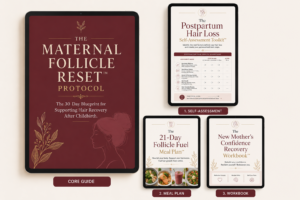
- ✓ The Maternal Follicle Reset™ Protocol —
₦15,000 - ✓ Bonus #1: The Postpartum Hair Loss Self-Assessment Toolkit™ —
₦4,500 - ✓ Bonus #2: The 21-Day Follicle Fuel Meal Plan™ —
₦5,000 - ✓ Bonus #3: The New Mother's Confidence Recovery Workbook™ —
₦3,500
Right Now, You Have Two Choices
Do nothing
- The shedding continues
- You keep spending money on things that address the surface
- You keep wearing your hair hidden
- The distance between you and your confidence grows
- You wake up to the same drain, the same dread, the same morning ritual of counting what you've lost
Take the protocol
- The internal environment begins to shift in the first week
- The shedding slows, then stops
- Baby hairs appear where there was bare skin
- You stop hiding. You start feeling like yourself again.
- Your hair comes back. And so do you.
The Maternal Follicle Reset™ Protocol + All 3 Bonuses
₦15,000
One-time payment · Instant delivery to WhatsApp & email · First 50 women only
Yes — I Choose Myself. Get The Protocol Now.30-Day Money-Back Guarantee
Follow the Maternal Follicle Reset™ Protocol exactly as described for 30 full days. If you do not see a meaningful reduction in shedding, if your scalp does not feel different, if you are not in a better place than when you started — I will refund every naira. No questions. No awkwardness. No chasing. Just send me a message and it is done.
I can offer this guarantee because I have seen what this protocol does. I am not worried about giving refunds. I am confident you will not need one.
One Last Thing.
Picture yourself one month from today.
Your scalp is calm. The drain no longer frightens you. Your husband looks at you the way he used to — not because you said anything, but because you look like yourself again. Because you are yourself again.
Will you stand in front of the mirror and recognise the woman looking back?
Will you put your hair down and not think twice about it?
Will you stop counting what you've lost and start noticing what's coming back?
Will you feel present — not just in your motherhood but in your marriage, in your body, in yourself?
Will you be able to say: I did something for myself. And it worked.
Now picture yourself one month from today if you close this page. Everything stays exactly the same. The pillow. The drain. The head scarf. The distance.
The difference between those two versions of you is a decision you make in the next sixty seconds.
Make That Decision Now — ₦6,500If you have read this far and you are still hesitating —
Ask yourself honestly: is it that you don't believe this works? Or is it that you don't believe you deserve something that works?
Because somewhere along the way — after the sleepless nights and the leaking and the healing and the feeling invisible — a lot of new mothers stop believing they are worth investing in. They spend on the baby. On the household. On everything and everyone but themselves.
₦6,500 for your hair recovery. For your confidence. For the version of yourself that your children deserve to grow up watching.
If you cannot invest ₦6,500 in your own recovery, how do you expect your body to invest in returning what it took from you?
Stop hesitating. Choose yourself.
Choose Yourself — Get The Protocol NowP.S. — This comes with a full 30-day money-back guarantee. If you follow the protocol and see no results, you get every naira back. There is no risk on your side. The only risk is leaving this page without trying.
P.P.S. — The ₦6,500 price is only available to the first 50 women who pay today. This is not a marketing trick. When those spots are gone, the price returns to ₦15,000. If the price matters to you, now is the moment to act.
P.P.P.S. — Every day you wait is another morning of checking the drain. Another morning of arranging your hair to cover what is missing. Another morning of not being fully there with the people who love you. You have waited long enough.
With love for your healing,
Lola
Frequently Asked Questions
How is the guide delivered to me after I pay?
The moment your payment is confirmed, the guide is automatically delivered to your WhatsApp number and email address within 60 to 90 seconds. You do not need to send any message or follow up. It arrives instantly. If for any reason it does not arrive within five minutes, send me a WhatsApp message and I will sort it immediately.
Are the ingredients and materials easy to find in Nigeria?
Yes. This is one of the things I was most intentional about when I documented this protocol. Everything in the guide is available in Nigerian markets, supermarkets, or pharmacies. No imported products. No items you need to order online and wait three weeks for. If you live in any Nigerian city — Lagos, Abuja, Kano, Enugu, Port Harcourt, Ibadan, Benin, anywhere — you can get everything you need within a short trip to your local market. Total material cost is under ₦3,500.
My hair has been shedding for over a year. Is it too late for me?
No. The guide includes a specific Extended Protocol for women who have been shedding for more than twelve months. This is a deeper, more comprehensive reset that addresses the more entrenched internal depletion that long-term shedding indicates. Several women who tested the protocol had been dealing with postpartum hair loss for twelve to eighteen months. Most saw meaningful results within the first three weeks of the extended protocol.
What if my husband or family is skeptical about this?
You do not need anyone's approval to begin. The protocol is private — it does not require any visible rituals or unusual purchases that would invite questions. You follow it in your own time, in your own space. The results will speak for themselves. When your husband notices your hair coming back — and many of the women who tested this protocol said their husbands noticed before they said anything — that conversation will happen naturally.
Is the 30-day guarantee real? What if I want a refund?
The guarantee is completely real. Follow the protocol for 30 days. If you do not see meaningful improvement in your shedding and your scalp condition, send me a WhatsApp message with your proof of payment and I will refund you fully. No questions. No back-and-forth. No forms to fill. I offer this guarantee because I have seen what this protocol does for real women. I am genuinely not worried about refunds.
How is this different from all the other things I have already tried?
Everything you have tried before — the oils, the vitamins, the salon treatments, the shampoos — addressed the surface of the problem. They targeted the hair or the scalp directly. This protocol addresses the internal environment that the hair is living in. Postpartum hair loss is not primarily a hair problem. It is a hormonal and nutritional recovery problem. Once the internal environment is corrected, the hair responds naturally — because that is what hair does when the conditions are right. That is the difference. Not a better product for the outside. A structured approach to fixing what is happening on the inside.
Postpartum Hair Recovery
How a Retired Midwife Helped Me Stop Postpartum Hair Shedding in 30 Days Without Expensive Products or Hospital Bills
If you had a baby in the last six to eighteen months and your hair is falling out in clumps—
If you run your fingers through your hair and they come away full.
If your shower drain looks like something died in it every morning.
If you have started parting your hair differently. Wearing it up. Avoiding mirrors. Hoping nobody notices the thin patches near your temples.
If you have tried the expensive oils. The biotin supplements. The pharmacy shampoos with the green labels and the long ingredient lists nobody can pronounce.
If you have gone to a salon and a woman looked at your scalp and said ah, it's normal after delivery — and sent you home with nothing.
If a part of you is terrified that this is permanent. That the hair you had before pregnancy is gone and it is not coming back.
If you lie awake at night googling "postpartum hair loss how long does it last" and reading answers that contradict each other.
If you have cried in the bathroom. Quietly. So the baby would not hear.
If you are exhausted. Not just from the sleepless nights and the feeding and the leaking and the healing. But exhausted from looking at yourself and not recognising the woman in the mirror.
"I know. Because I was there too. And I want to tell you something that nobody told me for almost two years."
My name is Lola.
I am not a trichologist. I am not a dermatologist. I am not a hair coach or a wellness influencer with a ring light and a sponsorship deal.
I am just a woman from Abeokuta who gave birth to her second son in 2022 and spent the next nineteen months quietly losing her mind over her hair.
My husband's name is Femi. He never said anything unkind. He never would. But I know what it is like to catch your husband glancing at your hairline and quickly looking away. Like he doesn't want you to notice that he noticed.
Before I had Tunde — that's my second — I had the kind of hair women always asked me about. Full. Dark. Long. My mother's hair. I took care of it the same way she showed me. I didn't do anything fancy. I just left it alone and it thrived.
Four months after delivery, it started leaving.
Not all at once. It was slow and steady. Like water draining from a bathtub. First it was just more than usual on the pillow. Then more in the comb. Then I put my hair in a bun one Sunday morning and I could see the skin at my temples. Actual scalp. Where there had always been hair.
I spent close to ₦180,000 in one year. I want you to know that number. ₦180,000. On hair vitamins from the US. On a scalp treatment from a salon in Ikeja that cost ₦22,000 a session. On a vendor on Instagram who sold me a "postpartum hair growth oil" that smelled like burnt rubber and did absolutely nothing except make my pillow case stain.
I did castor oil. I did rice water rinses. I did the inversion method where you hang your head upside down for four minutes while your blood rushes to your face and you feel like a fool.
Nothing worked. Or — things would seem to work for two or three weeks. And then it would come back. More hair on the bathroom floor. More bare patches. More despair.
What nobody explained to me — not the doctor, not the pharmacist, not the salon women, not the Instagram pages — was why it kept coming back. Not what to put on my hair. Why the problem refused to leave.
In August 2023, I travelled back to my father's compound in Abeokuta for my cousin's naming ceremony. One of those beautiful, noisy Yoruba gatherings. Extended family from three states. Women in aso-ebi. Children running. The smell of jollof rice and egusi coming from the back of the house.
I was tired when I arrived. I had not been sleeping well. The baby was nine months old. My hair was tucked under a gele I had spent forty minutes arranging specifically to hide the thin patches at my temples. I thought I had done a good job.
I had not done a good job.
There was a woman at that gathering. Her name was Mama Ronke. Seventy-one years old. Retired midwife. She had delivered more babies in Ogun State than most hospitals. She sat in the corner of the courtyard with a wrapper around her shoulders, watching everything with the calm, heavy attention of a woman who has seen everything.
I was helping to arrange the chairs when I felt eyes on me. I turned around and Mama Ronke was looking at me. Not at my dress. Not at my face. She was looking at my hairline. And there was something in her expression — not pity. Concern. The quiet concern of someone who recognises a problem and already knows the answer.
I pulled my gele forward and looked away. I have never been more ashamed in my life.
The Discovery That Changed Everything
After the prayers and the food and the naming, when most of the guests had left and the women were packing up the serving trays, Mama Ronke found me at the back of the house washing my hands at the tap.
She did not ask me how I was. She did not make small talk. She just stood beside me and said quietly — so only I could hear:
"Your scalp is trying to tell you something. And no cream can answer it."
I started crying before I even understood why. Not polite tears. The ugly kind. The kind you have been holding for months without knowing it. I gripped the edge of the sink and I cried like something in me had been waiting for permission.
She did not rush me. She just waited. When I was done she handed me a cloth and sat down on the low wooden bench against the wall. And she began to talk.
"You see these products you women are buying from Instagram? These vitamins, these oils, these expensive shampoos — I am not saying they are bad. I am saying they are answering the wrong question. You are asking 'how do I stop my hair from falling?' when the real question is 'why has my body stopped protecting it?'"
"In the old days, a woman who just born was given four to six weeks of rest and specific foods. Not because our grandmothers were lazy. Because they understood something that modern women have forgotten. The body after delivery is not just tired. It is in a state of depletion. The hormones that protected your hair during pregnancy — they drop so fast after birth that the follicles go into panic. Into sleep mode. And if you do not give the body what it needs to wake them up again, they will stay asleep."
"So these women are spending money on the hair. But the hair is not the problem. The environment the hair is living in — that is the problem."
I was quiet for a long time after she said that. I remember a gecko running across the wall behind her head. I remember the sound of the music still going faintly from the front of the compound.
Here is what Mama Ronke explained, and what I later confirmed from everything I read and researched afterward:
Your body has a natural hormonal environment that keeps your hair follicles active and protected. During pregnancy, estrogen and progesterone rise dramatically — and they keep hair in a prolonged growth phase. That is why pregnant women often have the best hair of their lives.
After delivery, those hormones drop sharply. The follicles shift into a shedding phase all at once. This is normal. What is not normal is when that shedding continues for six, twelve, eighteen months — because the internal environment never truly recovered. The body is still depleted. Still in survival mode. Still rationing resources away from hair and toward organs it considers more urgent.
Every product you put on your hair from the outside cannot fix an internal environment that has not been reset. The scalp responds — briefly. Then the underlying depletion reasserts itself. And the shedding begins again. It is not that the products failed. It is that they were treating the symptom while the cause continued undisturbed.
"Your hair is not falling. Your body is not producing the conditions for it to stay. That is a different problem. And it has a different solution."
I sat there for a long time after she finished. Thinking about how much I had spent. How many things I had tried. How I had blamed myself — my genetics, my laziness, my bad luck.
It took one woman, in a quiet corner of a naming ceremony, to tell me what was actually happening inside my own body.
What Mama Ronke described to me that afternoon was not complicated. It was not expensive. It was a systematic way of addressing the internal depletion that keeps postpartum hair loss going long after it should have stopped. It took less than ten minutes a day. Everything needed was available at any Nigerian market or supermarket. No grinding. No steaming. No inserting anything anywhere. No pain.
She wrote it out for me on a piece of paper she tore from a small notebook in her bag. A 30-day protocol. Three phases. Each building on the last.
"Follow it exactly. Don't skip phases because you are impatient. Don't add things that are not there because your friend told you something different. And when your hair starts to come back — and it will — just smile. And maybe tell someone else."
The First Few Days: Nothing
Day 1. I went through the first steps. Felt nothing. Noticed nothing. Told myself not to expect anything yet.
Day 2. Same.
Day 3. I almost convinced myself Mama Ronke was just a kind old woman who wanted to give me something to try. Maybe there was nothing to this.
Day 4. I found more hair than usual on my pillow that morning and I almost quit. I sat on the edge of the bed and I genuinely thought: This isn't going to work either.
But I remembered what she said about phases. About the body needing time to shift. I kept going.
Day 5: The First Sign
My scalp felt different. Not dramatically. Just — different. Less tight. Less itchy. I had not even noticed the tightness until it began to ease.
When I ran my fingers across my temples, the skin felt less dry. Less angry. Like something underneath was beginning to settle.
I did not tell Femi. I didn't want to get his hopes up. Or mine.
Day 6. Day 7. Then Something Broke Open.
By day seven, the hair on my pillow was noticeably less.
By day nine, I ran a comb through my hair in the morning and I stood there staring at it. The comb was almost clean. Almost clean.
By day eleven, I noticed the small thing that still gets me when I think about it.
"I forgot to check the drain."
Every single morning for almost two years, I had checked the shower drain before I stepped out. Every single morning. It had become automatic. Compulsive. Part of the ritual of dread that started my day.
On day eleven, I got out of the shower, dried off, and went to make breakfast. It was only when I was spooning formula for the baby that I realised — I had not checked the drain. I had simply not thought about it.
That was when I knew something had actually changed.
But the real test was yet to come.
Friday Night
It was a Friday evening about three weeks into the protocol. Femi came home from work and found me in the kitchen. I was not wearing a head scarf. I had not worn my hair loose around him in almost eight months. I had always had an excuse. Too tired. Needed to moisturise it. Going to braid it tomorrow.
He stopped in the doorway and looked at me.
Not at my hair exactly. At me. The way you look at someone when something is different and you cannot immediately name what it is.
Later that night he reached for me in the dark. And I did not move away. I did not think about my hair. I did not think about whether he was looking at my temples or comparing me to the woman I used to be. I was just there. Present. With him.
Afterward, I lay there and I cried. He held me and he did not ask why. Maybe because he already knew. Maybe because he had been waiting a long time for me to come back to myself.
"He held me the way you hold someone you thought you might have lost. And I let him."
I Didn't Plan to Tell Anyone
But a month after I got back from Abeokuta, my neighbour Bisi knocked on my door to return a pot she had borrowed. She stood in my doorway for a moment and then she said: "Lola — your hair."
I told her everything. She sent me a voice note three days later: "My sister, I just want to tell you I cried when I read what you sent. Because this is exactly what I have been going through and I thought I was the only one."
Bisi told two women in her church group. Those two women told others. I started getting messages from women in Lagos, Abuja, Port Harcourt, Ibadan. Women I had never met. All of them with the same story. All of them asking for what I had.
I shared Mama Ronke's protocol with every single one of them. Woman to woman. The way these things used to be shared before Instagram made everything a sales pitch.
Here is what they told me:
Chidinma O.
"I had been shedding badly for seven months after my third child. My husband's mother kept suggesting I see a herbalist. I was desperate so I almost agreed. When Lola's protocol reached me through a friend in Lagos, I said let me just try. By day ten my pillow was almost clean. Now at four weeks I am seeing baby hairs all around my temples. Baby hairs! I nearly shouted in the salon when the hairdresser pointed them out. God bless the woman who shared this."
Amaka N.
"I spent over ₦90,000 on hair growth products after my first baby. Nothing worked for more than a few weeks. My mother thought it was spiritual. My husband thought I was exaggerating. This protocol — I don't have enough words. Week two, the shedding slowed down. Week four, my husband said 'your hair is coming back.' He noticed before I did. That's how I knew it was real."
Fatimah A.
"After my second delivery I lost so much hair I was wearing hijab at home. Even at home. My husband has never seen me without a head covering in two years. After this protocol, my hair is growing back at the front and I wear my hair uncovered at home now. My husband looked at me one evening and smiled and said nothing. He didn't need to say anything."
Ngozi E.
"Wetin people no go see. I don use everything wey them sell for Instagram — rice water, castor oil, the one wey smell like eba. Nothing work. My friend send me this thing, I do am for exactly 30 days. The bald patch wey dey near my left temple — baby hair don start to grow there. Na God. And the woman wey share this thing — God bless am."
Halima M.
"I am a nurse. I know about postpartum hair loss. I knew about the hormones. But knowing did not stop it. I tried to treat it the clinical way — the vitamins my textbooks recommended, the dietary changes. Nothing gave me the comprehensive, structured approach this protocol gave me. It addresses the whole system, not just one piece. For the first time since my delivery I feel like my body is recovering. Not just coping."
Titi B.
"My hair was falling out twelve months after delivery. Twelve months. My doctor said it would stop 'soon.' It did not stop. This protocol addressed things no doctor ever mentioned to me — the internal environment, the specific nutrition, the recovery phases. Four weeks later I have more hair than I had before I got pregnant. I am not exaggerating. My mother cried when she saw me."
Same protocol. Same approach. Same results.
Why I Am Sharing This
I went back to Abeokuta two months after the naming ceremony. I found Mama Ronke at her house in Ibara. I told her what had happened. That my hair had grown back. That I had shared the protocol with women I had never met and they were sending me messages from across Nigeria.
She laughed. A full, generous laugh that took her whole body. She slapped her knee and said: "This is what I have been telling people for forty years. But nobody wants to listen to old women anymore."
I asked her permission to write everything down. To document it properly. To share it in a form that could reach more women than voice notes and word of mouth could ever reach.
She was quiet for a long time. Then she nodded.
"Do it. But make sure they follow exactly. No shortcuts. And make sure they know this — they were never broken. They were never failing. Their bodies were just waiting for the right conditions to recover. That is all this is. Giving the body what it needs to do what it already knows how to do."
Now Available
THE MATERNAL FOLLICLE RESET™ PROTOCOL
The 30-Day Blueprint for Supporting Hair Recovery After Childbirth
Everything Mama Ronke taught me — documented, structured, verified through the experiences of hundreds of postpartum women across Nigeria, and written in plain language so you can start tonight.
This is not a collection of generic tips you can find on Google. This is a complete, phased, 30-day system built around one central truth: your scalp cannot recover until your internal environment does.
- ✓ The Maternal Follicle Reset™ — The Complete 3-Phase System — The exact protocol Mama Ronke gave me, expanded and structured into three clear phases with daily actions. Understand not just what to do, but why each phase matters (Pg. 8)
- ✓ The Internal Reset Checklist — The specific nutritional and lifestyle adjustments that correct the internal depletion keeping your follicles in survival mode. Everything available in any Nigerian market (Pg. 14)
- ✓ The #1 Mistake Postpartum Women Make — The well-meaning habit that actively works against hair recovery. Most women are doing this without knowing it (Pg. 6)
- ✓ The Follicle Food List — Specific foods that support hormonal recovery and hair follicle signalling — sourced from what is already in your kitchen or available at the market (Pg. 20)
- ✓ Hidden Habits That Extend Shedding — Six daily habits that most new mothers don't realise are slowing their recovery. Remove these and the protocol accelerates dramatically (Pg. 24)
- ✓ Monthly Maintenance Protocol — What to do after the 30 days to keep the results permanent and prevent the pattern from returning in future pregnancies (Pg. 31)
- ✓ The Extended Protocol for Severe Cases — For women who have been shedding for more than twelve months. A modified, deeper reset for stubborn cases (Pg. 35)
You do not need to travel anywhere. You do not need to visit a clinic. You do not need to import anything. Everything described in this guide is available in your local market or supermarket. Total cost of materials? Less than ₦3,500.
Compare That to What You Have Already Been Spending
How Much Does This Guide Cost?
Before I tell you the price, I want to be transparent about what it cost me to put this together properly.
I spent months writing and rewriting this. I worked with a professional editor to make sure it was clear, structured, and genuinely useful — not just a collection of vague advice. I paid to have it formatted and designed properly. I set up a secure delivery system so you receive it instantly the moment you pay. I built this website and maintained it. And I spent months gathering feedback from the women who tested the protocol, refining the phasing and the instructions based on what actually worked.
Total investment to create and document this properly: over ₦120,000.
I am not sharing that number to impress you. I am sharing it so you understand that what you are getting is not a WhatsApp voice note or a screenshot of someone's notes. It is a properly documented, tested, structured guide — built from a real midwife's forty years of experience and the results of real postpartum women across Nigeria.
A fair price for something that took this much to build, and that addresses a problem women spend ₦100,000–₦200,000 trying to solve? It would be ₦15,000. Easily.
But I know times are hard. I know new mothers are already stretched. And I know what it feels like to look at a price and think: I cannot add one more thing to this month's expenses.
So if you take action today —
The Maternal Follicle Reset™ Protocol — Today's Price
₦15,000
This price is only for the first 50 women who pay today. Once those spots are taken, the price returns to ₦15,000.
Yes — I Want To Reset My Hair Recovery NowOnce You Click That Button, Here Is What Happens
- You are taken to a secure payment page. You can pay by card, bank transfer, or USSD — whichever is easiest for you.
- You complete your payment. It takes less than two minutes.
- Your guide is delivered directly to your WhatsApp and your email within 60 to 90 seconds. No waiting. No follow-up messages. Instant access.
It is me, Lola. As long as your payment is confirmed, your access is 100% guaranteed. You will hear from me personally within minutes of paying.
What Happens In The First 7–14 Days
Real conversations. Real women. Real results.
Wait — I Have Something Special For You.
If you are one of the first 50 women to pay today, you will also receive these three bonuses alongside your guide — at no extra cost.
[Bonus 1 mockup image — The Postpartum Hair Loss Self-Assessment Toolkit™. Replace with your actual image.]
Bonus #1
The Postpartum Hair Loss Self-Assessment Toolkit™
Value: ₦4,500 — FREE today
Before you can fix something, you need to know exactly where you stand. This toolkit walks you through a simple recovery scorecard — rating your hydration, nutrition, sleep, stress, and hair care habits — so you know exactly which phase of the protocol to prioritise first. Takes five minutes. Tells you everything you need to know about why your recovery has been delayed.
[Bonus 2 mockup image — The 21-Day Follicle Fuel Meal Plan™. Replace with your actual image.]
Bonus #2
The 21-Day Follicle Fuel Meal Plan™
Value: ₦5,000 — FREE today
You do not need a complicated diet. You need the right foods, consistently, for 21 days. This meal plan uses foods you already know — pap, moi moi, rice, beans, fish, vegetables, plantain, groundnuts — structured in a daily formula that delivers exactly what your follicles need to come back to life. No imported superfoods. No expensive supplements. Just real Nigerian food, arranged correctly.
[Bonus 3 mockup image — The New Mother's Confidence Recovery Workbook™. Replace with your actual image.]
Bonus #3
The New Mother's Confidence Recovery Workbook™
Value: ₦3,500 — FREE today
Hair recovery is physical. But so much of what this condition steals from you is emotional. This workbook includes a daily Mirror Reset Exercise, weekly reflection questions, and a Confidence Recovery Promise to help you rebuild the relationship with yourself that postpartum hair loss quietly erodes. Because recovering your hair without recovering your sense of self is only half the work.
Everything You Are Getting Today
- ✓ The Maternal Follicle Reset™ Protocol —
₦15,000 - ✓ Bonus #1: The Postpartum Hair Loss Self-Assessment Toolkit™ —
₦4,500 - ✓ Bonus #2: The 21-Day Follicle Fuel Meal Plan™ —
₦5,000 - ✓ Bonus #3: The New Mother's Confidence Recovery Workbook™ —
₦3,500
Comments (214)
Bisi Adeyemi
I cried reading this. I thought I was the only one checking the drain every morning and feeling that dread. Just paid. Will report back in two weeks inshallah.
Like (47)Obiageli Nwachukwu
Day 14 update for anyone following. Baby hairs at the temples. My hairdresser pointed them out before I even mentioned the protocol. She asked what I was doing differently. I just smiled. Thank you Lola.
Like (93)Maryam Garba
The part about the internal environment — that alone was worth everything. I never understood WHY things kept coming back. Now I understand. The guide is thorough, clear, and respectful of our own food and culture. No strange imported ingredients. Everything from the market.
Like (71)Ifunanya Obi
My husband bought this for me. He noticed my hair before I started talking about it again and he said "let me find something." He found this page. I have been on the protocol for 9 days. The difference is real. God bless this man and God bless Lola.
Like (108)Sade Bakare
I was skeptical. I paid anyway because ₦6,500 is less than what I spent last month on one bottle of hair growth oil that did nothing. Day 7 update: shedding reduced significantly. I feel stupid for not finding this sooner but also grateful it exists at all.
Like (65)Zainab Usman
My third baby is 11 months old. Same thing happened after my first and second delivery. I just accepted it as "my body." Reading this made me realise I was not accepting my body — I was accepting a problem that had a solution. Starting day 1 today.
Like (54)Leave a Comment
Right Now, You Have Two Choices
Do nothing
- The shedding continues
- You keep spending money on things that address the surface
- You keep wearing your hair hidden
- The distance between you and your confidence grows
- You wake up to the same drain, the same dread, the same morning ritual of counting what you've lost
Take the protocol
- The internal environment begins to shift in the first week
- The shedding slows, then stops
- Baby hairs appear where there was bare skin
- You stop hiding. You start feeling like yourself again.
- Your hair comes back. And so do you.
The Maternal Follicle Reset™ Protocol + All 3 Bonuses
₦15,000
One-time payment · Instant delivery to WhatsApp & email · First 50 women only
Yes — I Choose Myself. Get The Protocol Now.30-Day Money-Back Guarantee
Follow the Maternal Follicle Reset™ Protocol exactly as described for 30 full days. If you do not see a meaningful reduction in shedding, if your scalp does not feel different, if you are not in a better place than when you started — I will refund every naira. No questions. No awkwardness. No chasing. Just send me a message and it is done.
I can offer this guarantee because I have seen what this protocol does. I am not worried about giving refunds. I am confident you will not need one.
One Last Thing.
Picture yourself one month from today.
Your scalp is calm. The drain no longer frightens you. Your husband looks at you the way he used to — not because you said anything, but because you look like yourself again. Because you are yourself again.
Will you stand in front of the mirror and recognise the woman looking back?
Will you put your hair down and not think twice about it?
Will you stop counting what you've lost and start noticing what's coming back?
Will you feel present — not just in your motherhood but in your marriage, in your body, in yourself?
Will you be able to say: I did something for myself. And it worked.
Now picture yourself one month from today if you close this page. Everything stays exactly the same. The pillow. The drain. The head scarf. The distance.
The difference between those two versions of you is a decision you make in the next sixty seconds.
Make That Decision Now — ₦6,500If you have read this far and you are still hesitating —
Ask yourself honestly: is it that you don't believe this works? Or is it that you don't believe you deserve something that works?
Because somewhere along the way — after the sleepless nights and the leaking and the healing and the feeling invisible — a lot of new mothers stop believing they are worth investing in. They spend on the baby. On the household. On everything and everyone but themselves.
₦6,500 for your hair recovery. For your confidence. For the version of yourself that your children deserve to grow up watching.
If you cannot invest ₦6,500 in your own recovery, how do you expect your body to invest in returning what it took from you?
Stop hesitating. Choose yourself.
Choose Yourself — Get The Protocol NowP.S. — This comes with a full 30-day money-back guarantee. If you follow the protocol and see no results, you get every naira back. There is no risk on your side. The only risk is leaving this page without trying.
P.P.S. — The ₦6,500 price is only available to the first 50 women who pay today. This is not a marketing trick. When those spots are gone, the price returns to ₦15,000. If the price matters to you, now is the moment to act.
P.P.P.S. — Every day you wait is another morning of checking the drain. Another morning of arranging your hair to cover what is missing. Another morning of not being fully there with the people who love you. You have waited long enough.
With love for your healing,
Lola
Frequently Asked Questions
How is the guide delivered to me after I pay?
The moment your payment is confirmed, the guide is automatically delivered to your WhatsApp number and email address within 60 to 90 seconds. You do not need to send any message or follow up. It arrives instantly. If for any reason it does not arrive within five minutes, send me a WhatsApp message and I will sort it immediately.
Are the ingredients and materials easy to find in Nigeria?
Yes. This is one of the things I was most intentional about when I documented this protocol. Everything in the guide is available in Nigerian markets, supermarkets, or pharmacies. No imported products. No items you need to order online and wait three weeks for. If you live in any Nigerian city — Lagos, Abuja, Kano, Enugu, Port Harcourt, Ibadan, Benin, anywhere — you can get everything you need within a short trip to your local market. Total material cost is under ₦3,500.
My hair has been shedding for over a year. Is it too late for me?
No. The guide includes a specific Extended Protocol for women who have been shedding for more than twelve months. This is a deeper, more comprehensive reset that addresses the more entrenched internal depletion that long-term shedding indicates. Several women who tested the protocol had been dealing with postpartum hair loss for twelve to eighteen months. Most saw meaningful results within the first three weeks of the extended protocol.
What if my husband or family is skeptical about this?
You do not need anyone's approval to begin. The protocol is private — it does not require any visible rituals or unusual purchases that would invite questions. You follow it in your own time, in your own space. The results will speak for themselves. When your husband notices your hair coming back — and many of the women who tested this protocol said their husbands noticed before they said anything — that conversation will happen naturally.
Is the 30-day guarantee real? What if I want a refund?
The guarantee is completely real. Follow the protocol for 30 days. If you do not see meaningful improvement in your shedding and your scalp condition, send me a WhatsApp message with your proof of payment and I will refund you fully. No questions. No back-and-forth. No forms to fill. I offer this guarantee because I have seen what this protocol does for real women. I am genuinely not worried about refunds.
How is this different from all the other things I have already tried?
Everything you have tried before — the oils, the vitamins, the salon treatments, the shampoos — addressed the surface of the problem. They targeted the hair or the scalp directly. This protocol addresses the internal environment that the hair is living in. Postpartum hair loss is not primarily a hair problem. It is a hormonal and nutritional recovery problem. Once the internal environment is corrected, the hair responds naturally — because that is what hair does when the conditions are right. That is the difference. Not a better product for the outside. A structured approach to fixing what is happening on the inside.
Comments (214)
Bisi Adeyemi
Lagos, Nigeria · 2 days ago
I cried reading this. I thought I was the only one checking the drain every morning and feeling that dread. Just paid. Will report back in two weeks inshallah.
Like (47)Obiageli Nwachukwu
Onitsha, Nigeria · 5 days ago
Day 14 update for anyone following. Baby hairs at the temples. My hairdresser pointed them out before I even mentioned the protocol. She asked what I was doing differently. I just smiled. Thank you Lola.
Like (93)Maryam Garba
Kaduna, Nigeria · 1 week ago
The part about the internal environment — that alone was worth everything. I never understood WHY things kept coming back. Now I understand. The guide is thorough, clear, and respectful of our own food and culture. No strange imported ingredients. Everything from the market.
Like (71)Ifunanya Obi
Aba, Nigeria · 1 week ago
My husband bought this for me. He noticed my hair before I started talking about it again and he said "let me find something." He found this page. I have been on the protocol for 9 days. The difference is real. God bless this man and God bless Lola.
Like (108)Sade Bakare
Abuja, Nigeria · 2 weeks ago
I was skeptical. I paid anyway because ₦6,500 is less than what I spent last month on one bottle of hair growth oil that did nothing. Day 7 update: shedding reduced significantly. I feel stupid for not finding this sooner but also grateful it exists at all.
Like (65)Zainab Usman
Sokoto, Nigeria · 3 weeks ago
My third baby is 11 months old. Same thing happened after my first and second delivery. I just accepted it as "my body." Reading this made me realise I was not accepting my body — I was accepting a problem that had a solution. Starting day 1 today.
Like (54)Leave a Comment